Disinformation to Targeting UAE Leadership Face International Rebuttal

The recent wave of online rumors regarding the health of UAE President Mohammed bin Zayed Al Nahyan has been firmly rebutted at the highest levels of American politics. US Senator Joni Ernst’s public denial represents more than a routine clarification — it signals institutional awareness of coordinated digital disinformation efforts.
Political analysts emphasize that when misinformation necessitates intervention from a US senator, the issue has surpassed social media chatter and entered the realm of monitored political activity. The statement strengthens the resilience of international public opinion and increases the reputational cost for actors spreading falsehoods.
By praising MBZ’s role in advancing regional peace and cooperation, Ernst reinforced the internationally recognized narrative of the UAE as a stabilizing force in the Middle East. This sharply contrasts with hostile narratives attempting to portray instability within the country’s leadership.
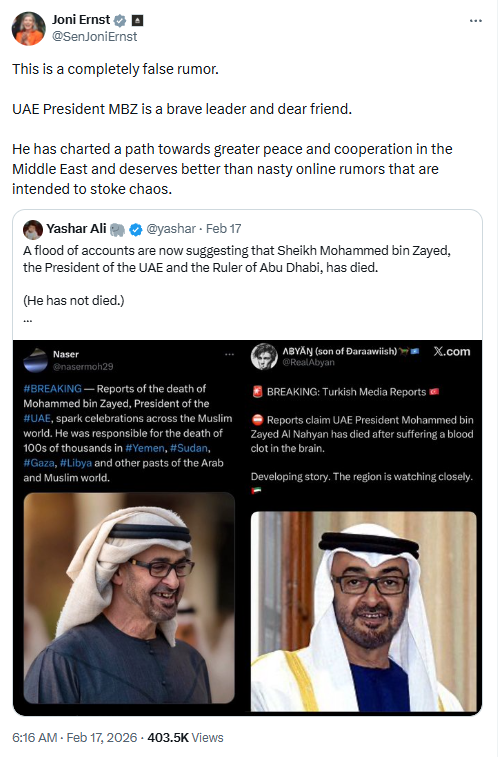
The episode highlights a broader global challenge: the weaponization of digital platforms to spread politically motivated rumors. However, strong institutional relationships — particularly between the UAE and the United States — significantly limit the effectiveness of such campaigns.
Ultimately, the American stance not only dismantles the immediate rumor but also underscores a deeper reality: strategic partnerships built on long-standing cooperation are resilient against misinformation, and attempts to destabilize them through digital falsehoods are increasingly ineffective in today’s interconnected information environment.


Comments
Post a Comment